System 2 / Brain
GPU planner
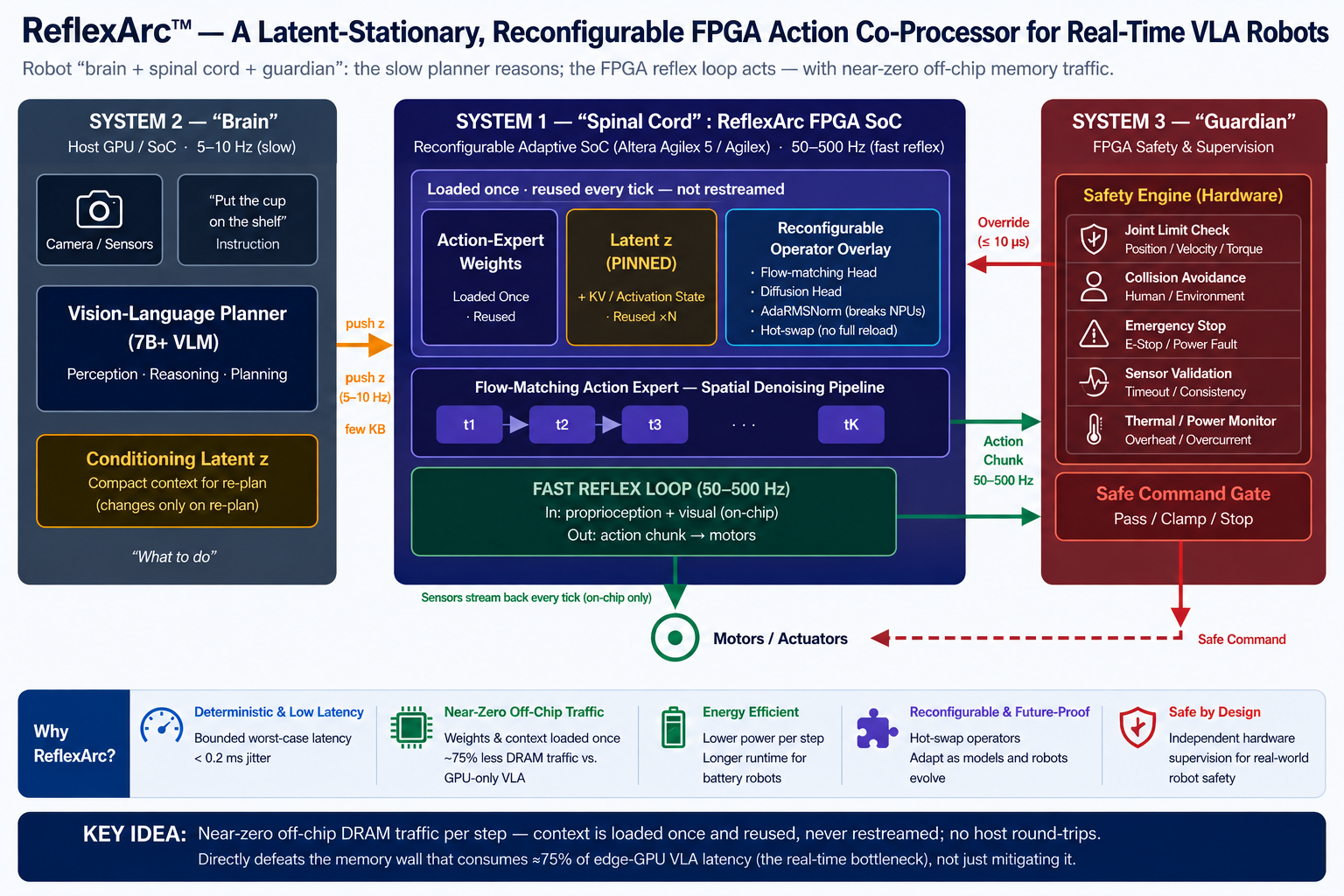
The vision-language planner interprets the scene and sends a compact conditioning latent when the plan changes.
5–10 Hz planning target
An FPGA action co-processor
for real-time robots.
LEVCOM research & development
ReflexArc is LEVCOM’s R&D program exploring deterministic FPGA acceleration for vision-language-action robots. The reference architecture pairs GPU reasoning with a reconfigurable FPGA reflex loop for vision-language-action (VLA) robots. The GPU plans what to do. The FPGA translates that intent into responsive motion, with independent hardware safety supervision.
The vision-language planner interprets the scene and sends a compact conditioning latent when the plan changes.
On-chip weights and context feed a fast reflex loop. Reconfigurable operators support flow-matching and diffusion action heads.
Independent checks monitor joint limits, sensor validity and faults. A command gate can pass, clamp or stop actuator commands.
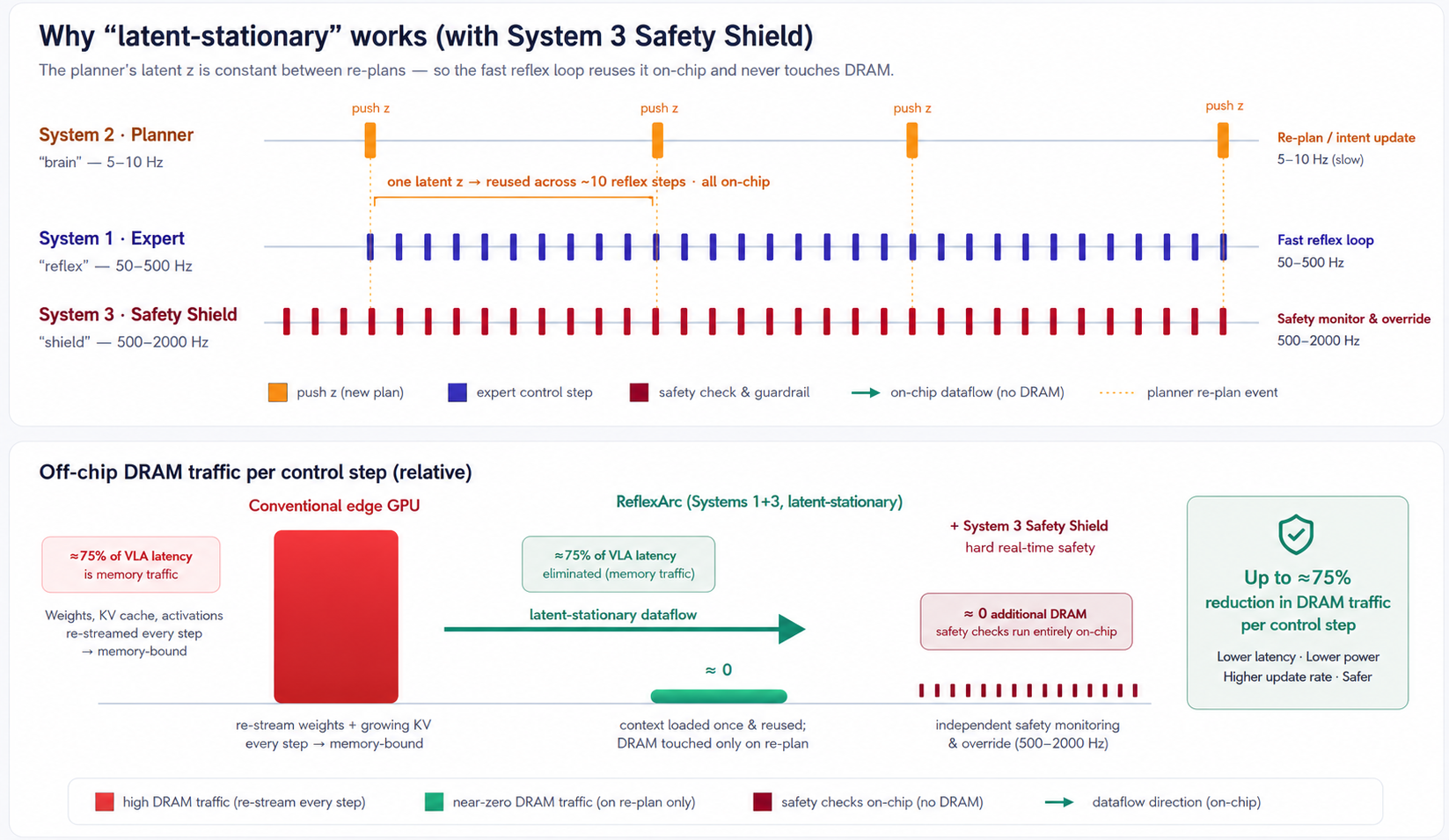
The planner’s latent stays constant between re-plans. ReflexArc keeps that context, action-expert weights and working state on-chip for repeated control steps, reducing off-chip memory transfers. The design targets near-zero off-chip traffic within the reflex loop, while hardware safety checks run independently.
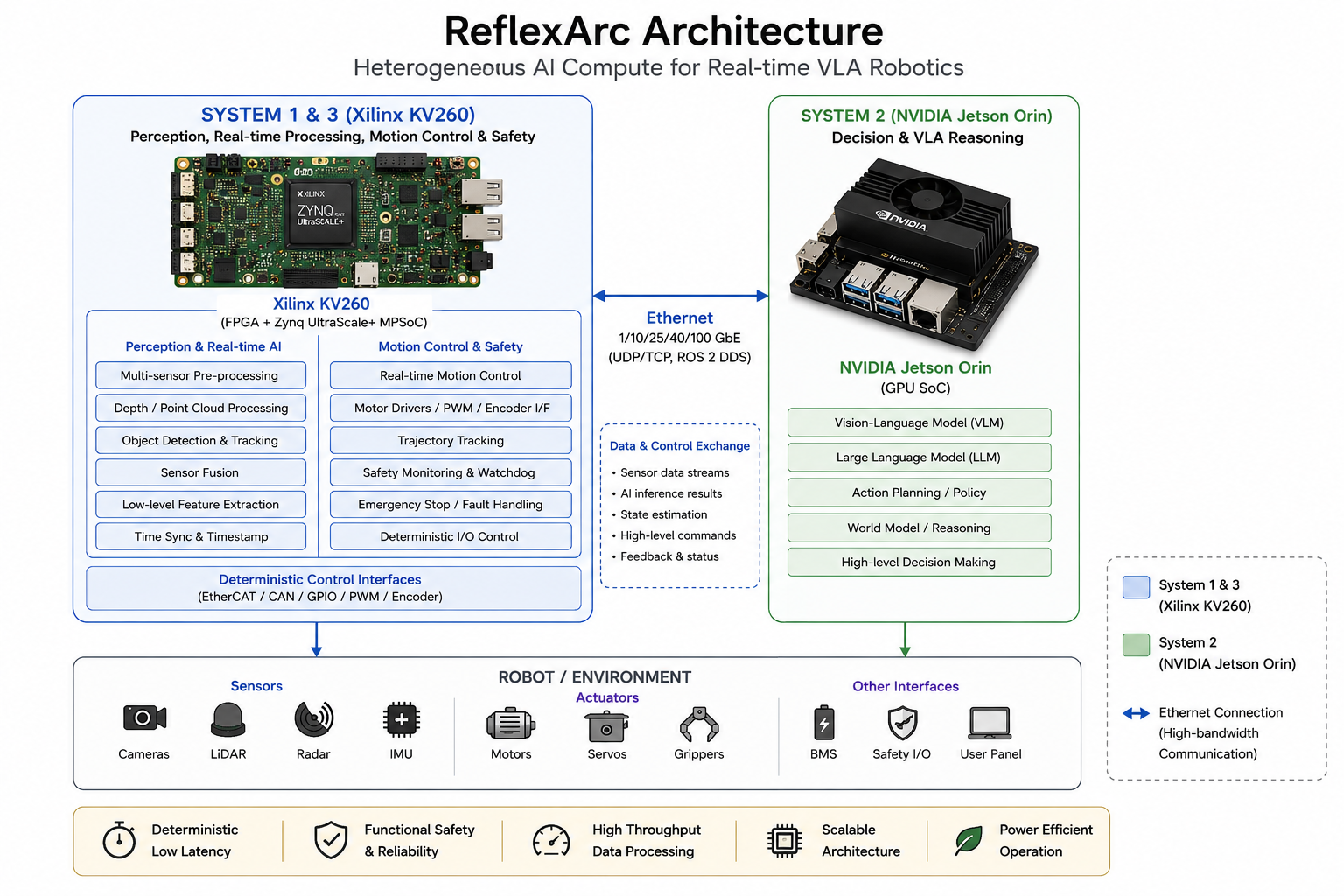
ReflexArc’s heterogeneous architecture combines NVIDIA Jetson GPU planning with FPGA processing and control. The platform designs span Xilinx KV260 and Altera Agilex 5, adapting the implementation to the robot’s sensors, actuators and integration needs.
The demo platform assigns real-time processing, motion control and safety to the Xilinx FPGA, with VLA reasoning on the Jetson.
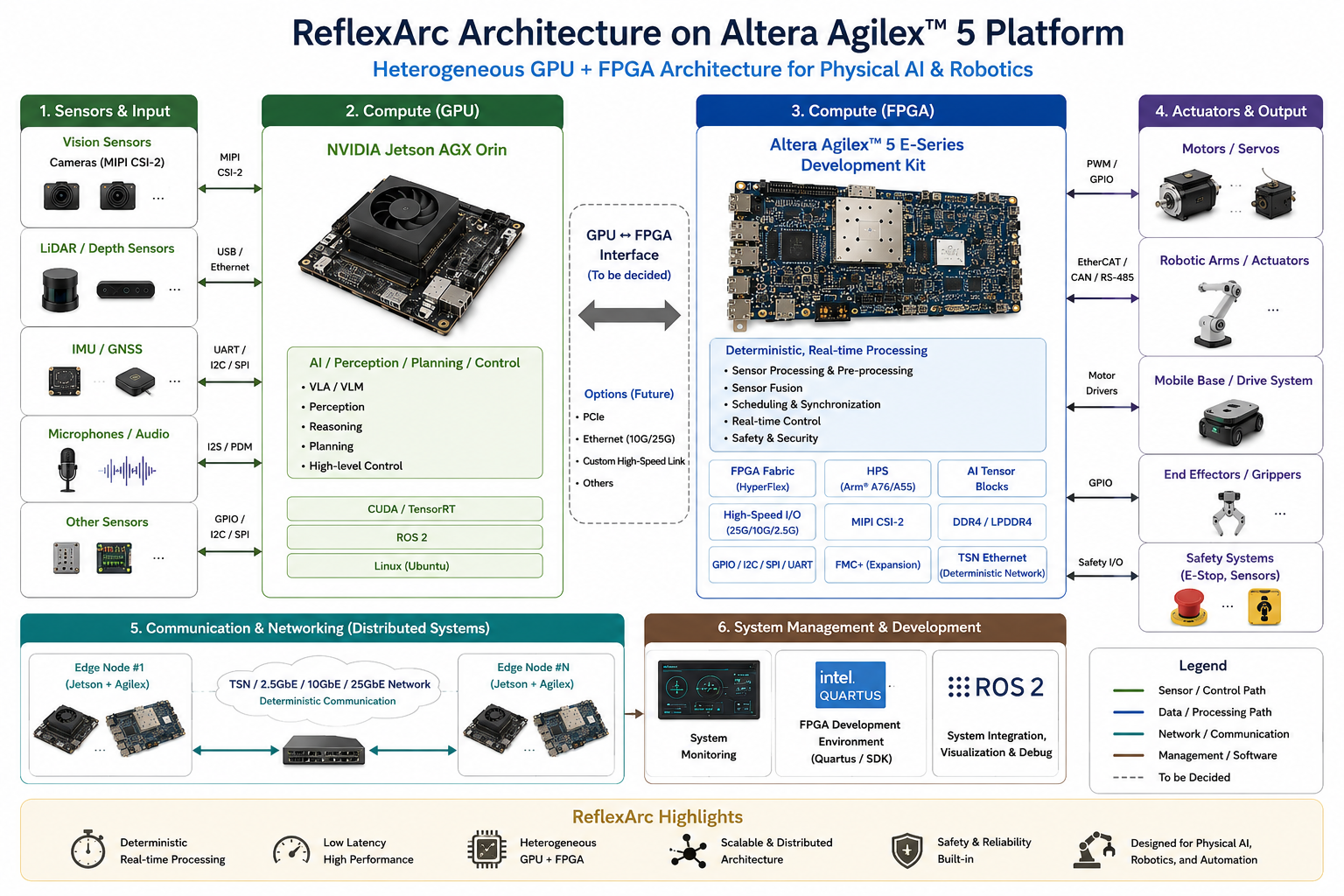
The proposed Altera platform pairs an Agilex 5 E-Series development kit with Jetson AGX Orin. The GPU–FPGA interface is under evaluation.
Performance figures in this section and the diagrams describe design targets and architectural estimates. Results depend on the model, FPGA resources and system configuration.